Refund and return requests in public comments: a calm playbook
"I want my money back" under your ad is read by every buyer who opens the comments. How to answer refund and return requests in public, move the details private, and spot the ones that need a person.
Playbooks 6 min read
On this page
Sooner or later, it happens under your best ad. "Still waiting on my refund." "This broke in a week, I want my money back." "How do I return this?" Sometimes politely, sometimes in capitals.
The instinct is to make these disappear. Resist it. Everyone deciding whether to buy is reading how you handle the unhappy customer, and a calm, fast answer in public does more for your store than a spotless thread. This playbook covers how to sort refund and return comments, what to say in public, what to move private, and which ones need a person before anyone replies.
Why hiding refund requests backfires
Hiding a real customer's refund request feels tidy for about an hour. Then one of three things happens: they notice and post again, angrier; they post the same complaint under three other ads; or they take it somewhere you cannot hide it at all, such as a review site or their card issuer.
Meanwhile, the people who saw the comment before it vanished saw it vanish. Our guide to negative comments on ads covers the wider line between what to hide and what to answer. For refunds, the line is simple: a real customer asking for their money gets an answer, not a hide.
Sort before you reply
Refund and return comments look alike and need different handling.
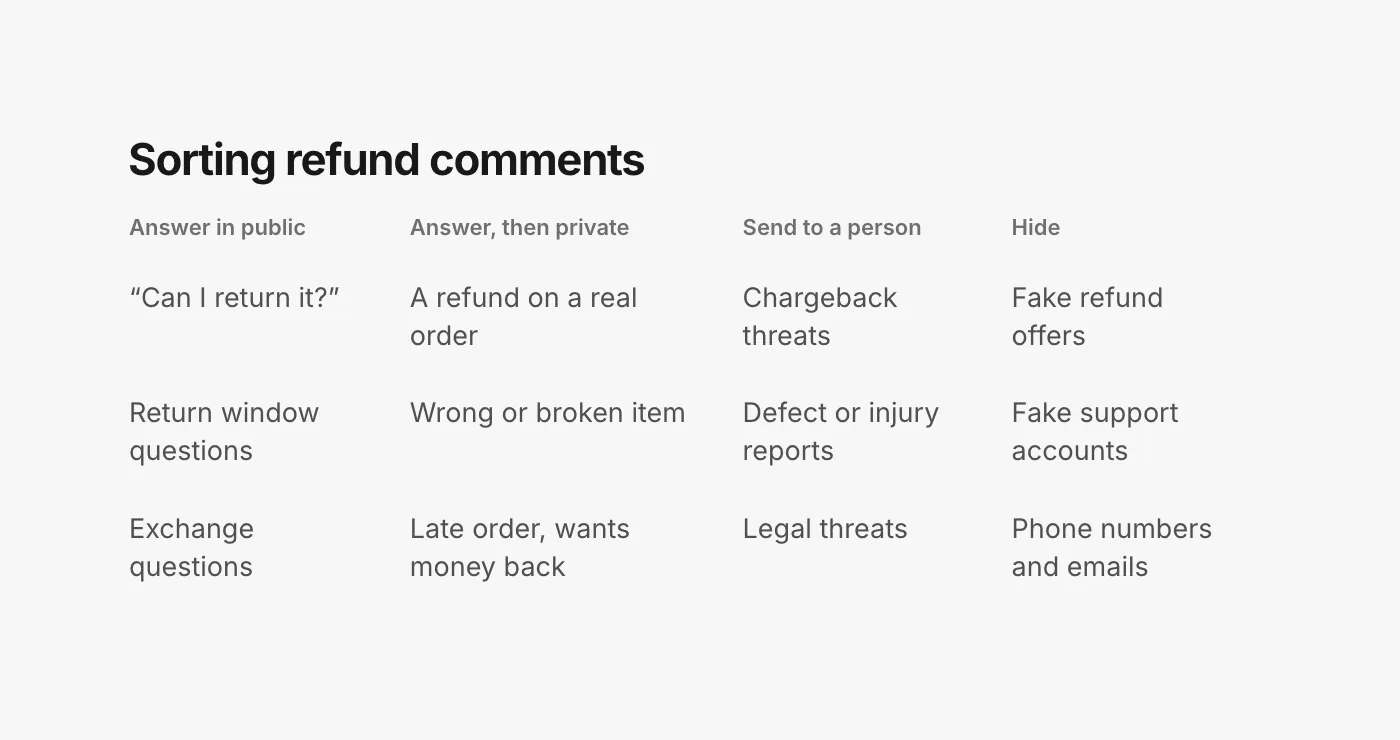
- Policy questions. "Can I return it if it doesn't fit?" This is a shopper, not a problem. Answer in public with the policy, in one line.
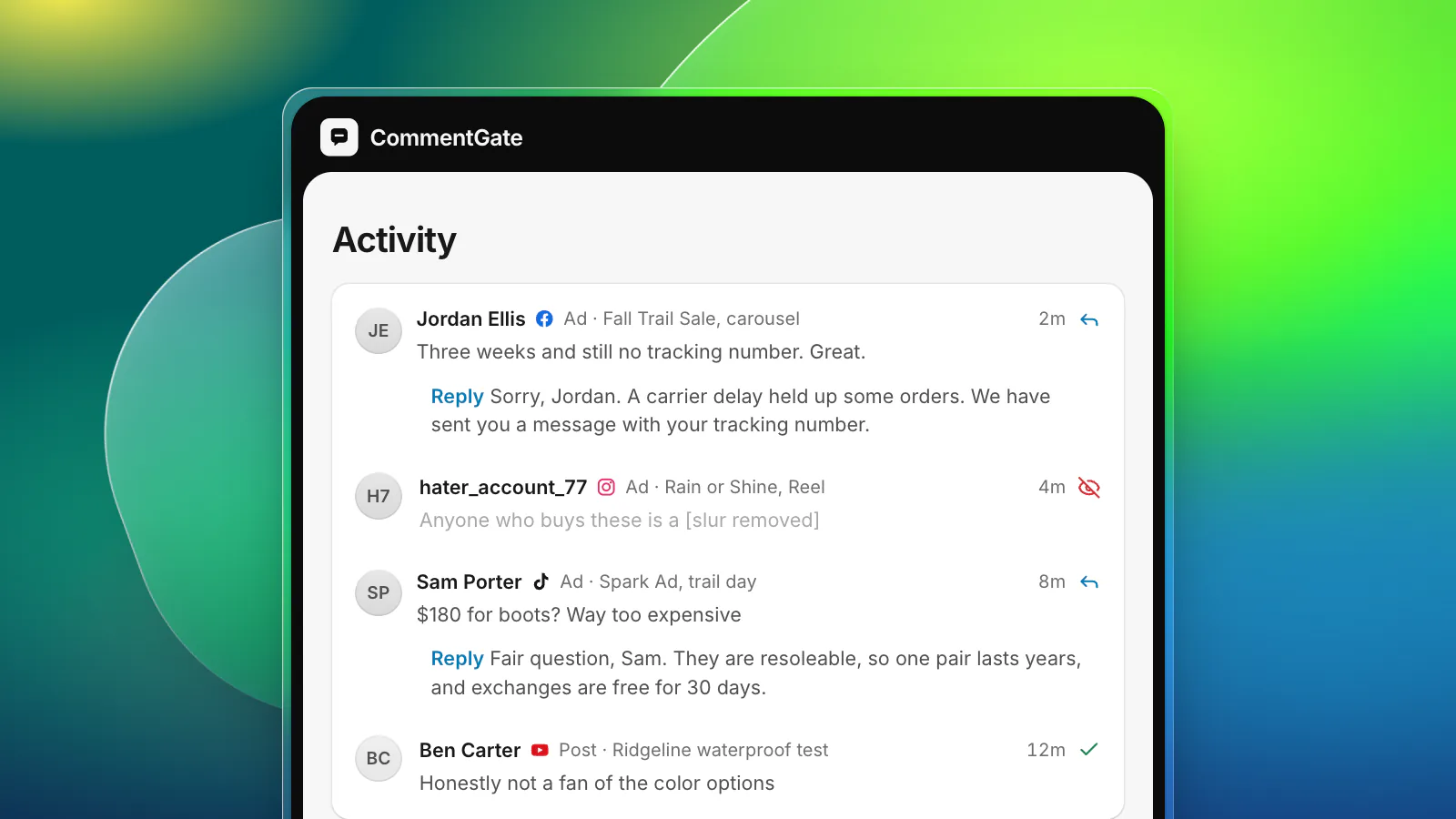
- A request on a real order. "Ordered two weeks ago, it arrived broken, how do I get a refund?" Answer in public, briefly, and move the details to a private conversation.
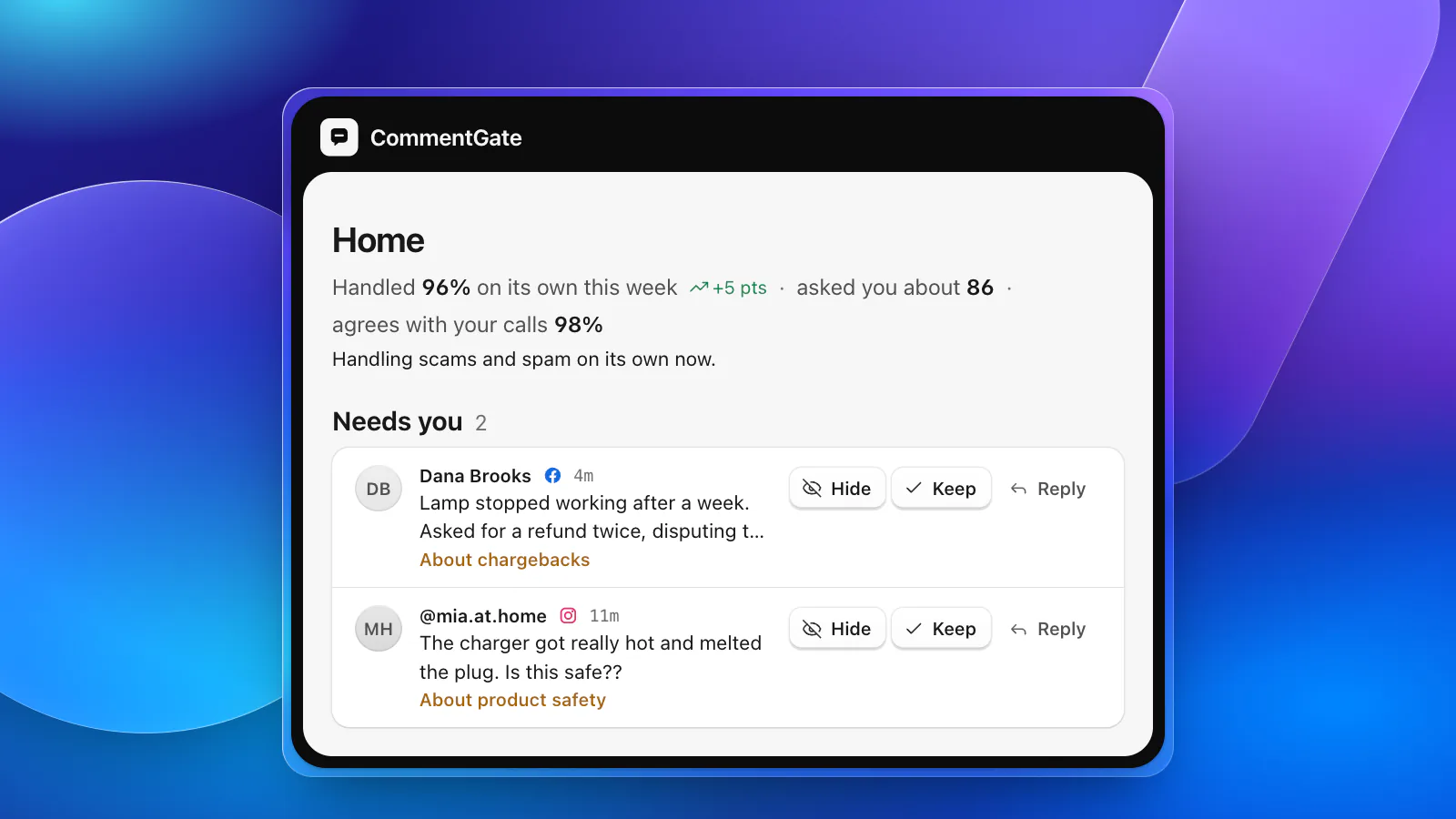
- Judgement calls. A chargeback threat, a defect report with an injury, a legal threat. These go to a person who can actually decide, before anyone replies.
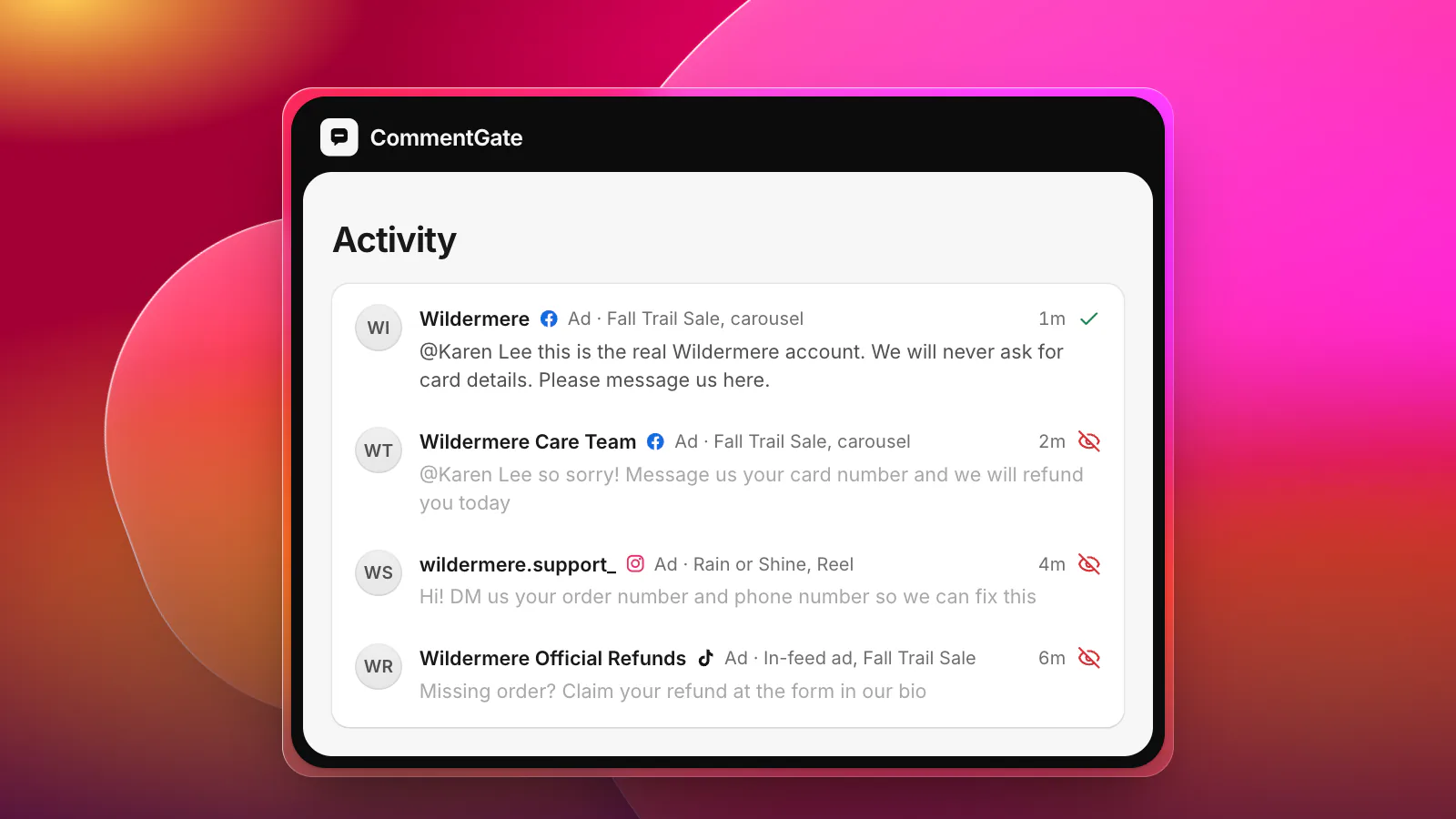
- Things to hide. A fake "refund department" account replying to your customer, or a customer who posted their phone number, email or order details for everyone to see.
The public reply: three parts
For anything in group 2, the public reply has three parts and no more:
- Acknowledge, by name. "Sorry about this, Dana."
- One fact that helps. "Every order is covered for 30 days."
- The next step, in private. "We have sent you a message to sort out the refund."
Put together: "Sorry about this, Dana. Every order is covered for 30 days, and we have sent you a message to sort out the refund today."
What it leaves out matters as much:
- No blame. Not the carrier's fault, not the customer's. The thread does not need to know whose fault it was.
- No arguing about the facts in public. If you think the story is wrong, sort it out privately.
- No request for details in public. Never ask for an order number, an email or a card number in a comment reply.
- No promises you cannot keep. "Refunded today" only if it will be.
The private conversation
On Facebook and Instagram, a business can answer a comment with one private message, sent within 7 days of the comment, and the conversation can continue if the person replies (Messenger private replies, Instagram private replies). Because you may only get one message, make it complete: the apology, the one thing you need from them (usually the order number), and when they will hear back.
On Instagram, that message lands in Requests for people who do not follow you, so the public reply should say where to look. On TikTok, YouTube and Threads, where a message from a comment is not available for most brands, point to your contact form or support page instead.
When the refund is done, go back to the thread: "All sorted with Dana. Thanks for your patience!" It takes ten seconds, and it turns the most visible complaint under your ad into proof that you fix things.
If the refund is for a late order
In the US, the FTC's Mail, Internet, or Telephone Order Merchandise Rule covers orders that do not ship on time. If you cannot ship within the time you stated (or within 30 days when you stated none), you must offer the buyer the choice to accept the delay or cancel. When they cancel, the refund has to go out "within seven (7) working days" for cash, check or money order, and "within one (1) billing cycle" for credit sales (FTC business guide to the rule). Read the guide, because "we'll refund you when the supplier refunds us" is not an answer the rule allows.
Chargeback threats go to a person
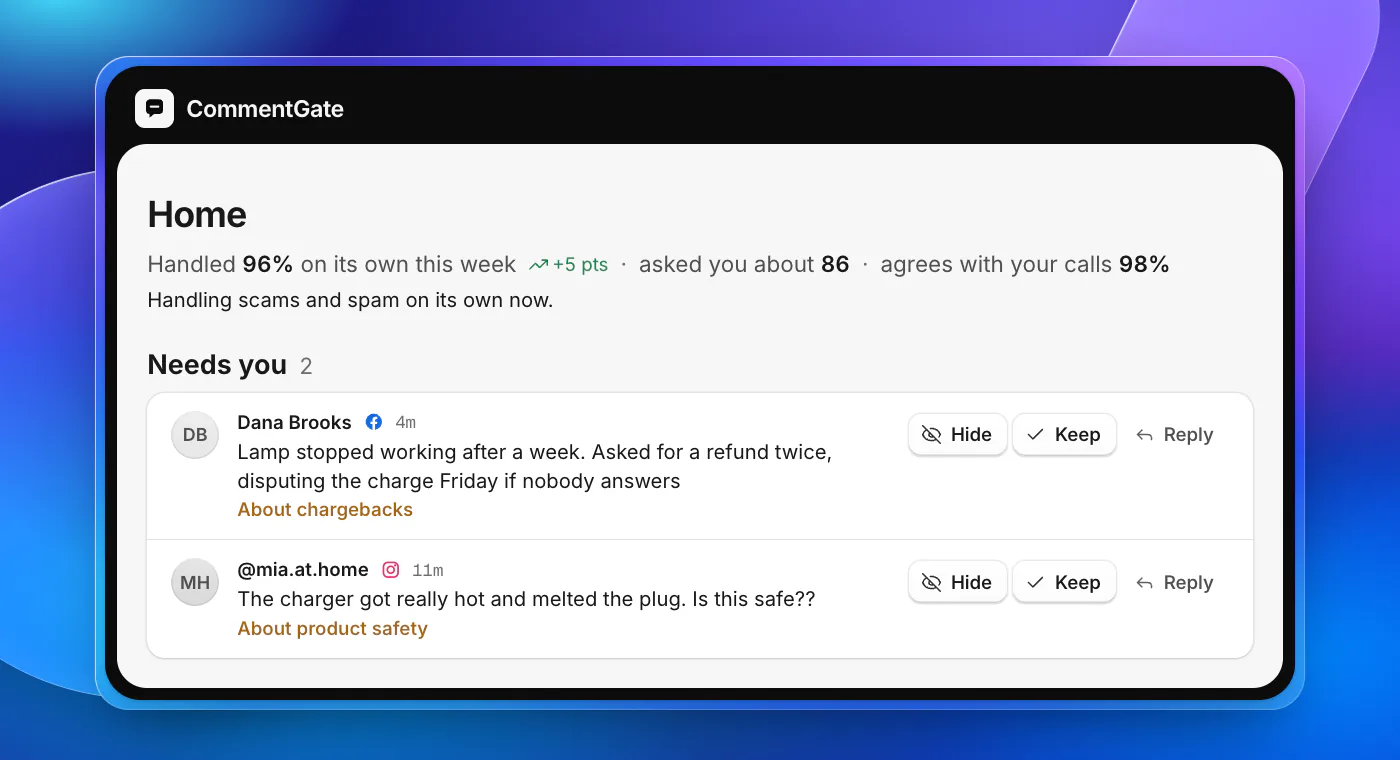
"If I don't hear back by Friday I'm disputing the charge" is not a moderation decision. It is a customer telling you they are about to take the money back through their bank, and they may well be entitled to: the FTC tells consumers they can dispute charges for things "you didn't accept or weren't delivered as agreed", with the letter reaching the card issuer "within 60 days after the first bill with the error was sent to you" (FTC: using credit cards and disputing charges).
So do not hide it, and do not let a generic reply go out. Someone who can issue a refund should answer the same day, in public with the three-part reply and in private with the fix. See our chargeback reply templates for wording, and the glossary entry on chargebacks for the basics.
The same goes for defect reports with an injury or a safety risk ("the charger melted", "the strap snapped and cut my ankle"). Answer quickly, take it private, and make sure someone who can check the product sees it.
Watch for fake refund offers
Refund complaints are bait for scammers. Within minutes of a customer posting "still waiting on my refund", an account with your logo may reply: "So sorry! Message us your card number and we will refund you today." Hide it at once, and warn the customer in your own reply: "That account is not us. We will never ask for card details in a message." Our guide to fake support accounts covers how to report the account.
If the customer posted their own details (a phone number, an email, an order number), answer first and then hide the comment. On Instagram the order matters: you cannot reply to a hidden comment (IG Comment replies).
When refunds pile up under one ad
One refund request is a customer. Twenty under one ad in a day is a signal: a bad batch, a shipping failure, or a product that does not match the ad. Stop answering one by one and fix the cause. Pause the ad if it is still selling the problem, post one honest update, and see the crisis day checklist if it keeps growing.
Doing this with CommentGate
CommentGate handles each group the way this playbook does:
- Policy questions get a drafted reply from your return policy in your notes, sent on its own or after your approval.
- Refund requests on real orders are kept up, and the reply can go out publicly with a private message on Facebook and Instagram.
- Chargeback threats and safety reports wait in Needs you with a one-line reason, and you can assign them to whoever issues refunds, with a note only your team sees.
- Fake refund offers are hidden within seconds on Facebook and Instagram by Hide scams and fake giveaways, and Hide phone numbers and emails keeps customers' details out of public threads.
- Crisis mode holds every new comment for a person when a problem turns into a pile-up.
For more wording, see the returns and refunds templates.