Health and results claims in your comments: what the FTC says about testimonials
"This cured my eczema." "Lost 30 pounds in a month." Comments like these under your ads feel like free social proof. Here is what the FTC’s endorsement guidance says about testimonials and results claims, and how to answer, keep or escalate them without making a claim you cannot back up.
Guides 6 min read
On this page
If you sell skincare, supplements, fitness gear, sleep products or anything that touches the body, your ad comments will eventually fill with claims you would never make yourself. "This cleared my acne in three days." "I lost 30 pounds in a month." "Finally off my anxiety meds thanks to these." They are heartfelt, they are free, and they are exactly the kind of social proof a media buyer wants under a winning ad.
They are also claims. And in the US, the Federal Trade Commission has a lot to say about claims made through the words of customers.
Why a customer's words can become your claim
The FTC's Endorsement Guides say an ad that uses consumer endorsements about how a product performs "will be interpreted as representing that the product is effective for the purpose depicted". The advertiser then needs the same proof it would need "if it had made the representation directly", and the Guides add bluntly: "Consumer endorsements themselves are not competent and reliable scientific evidence" (FTC: Guides Concerning the Use of Endorsements and Testimonials in Advertising, 16 CFR Part 255).
The FTC's Health Products Compliance Guidance applies the same idea across every channel: advertisers are liable for misleading use of endorsements "whether in traditional advertising media like TV and print, on the internet, in social media", and they "should not make claims through consumer testimonials or expert endorsements that would be deceptive or couldn't be substantiated if the advertiser made them directly" (FTC: Health Products Compliance Guidance).
The guidance does not draw an exact line for a stranger's comment that you never touched. What is clear is the direction of travel: the more you use a customer's claim, the more it looks like your ad. Replying "So glad it cured your eczema!", pinning the comment, screenshotting it into your next creative, or resharing a customer's post all move the claim toward you. The practical rule is simple: never amplify a health claim you could not make yourself.
"Results may vary" does not fix it
The instinct is to reply with a disclaimer. The FTC says it does not work. Endorsements claiming specific results "usually will be interpreted to mean that the endorser's experience reflects what others can also expect", and "Statements like 'Results not typical' or 'Individual results may vary' won't change that interpretation" (FTC: Endorsement Guides, what people are asking). The advertiser's two choices are to have proof that the results are typical, or to clearly disclose what people can generally expect.
So a cheerful "Amazing results! Results may vary" under a weight-loss comment is the worst of both: it amplifies the claim and adds a disclaimer the FTC has already said does not cure it.
The Health Products guidance also explains why a pile of happy comments is not evidence: "Even if consumer experiences are genuine, they may be attributable to a placebo effect or other factors unrelated to the product" (FTC).
Four kinds of health comment
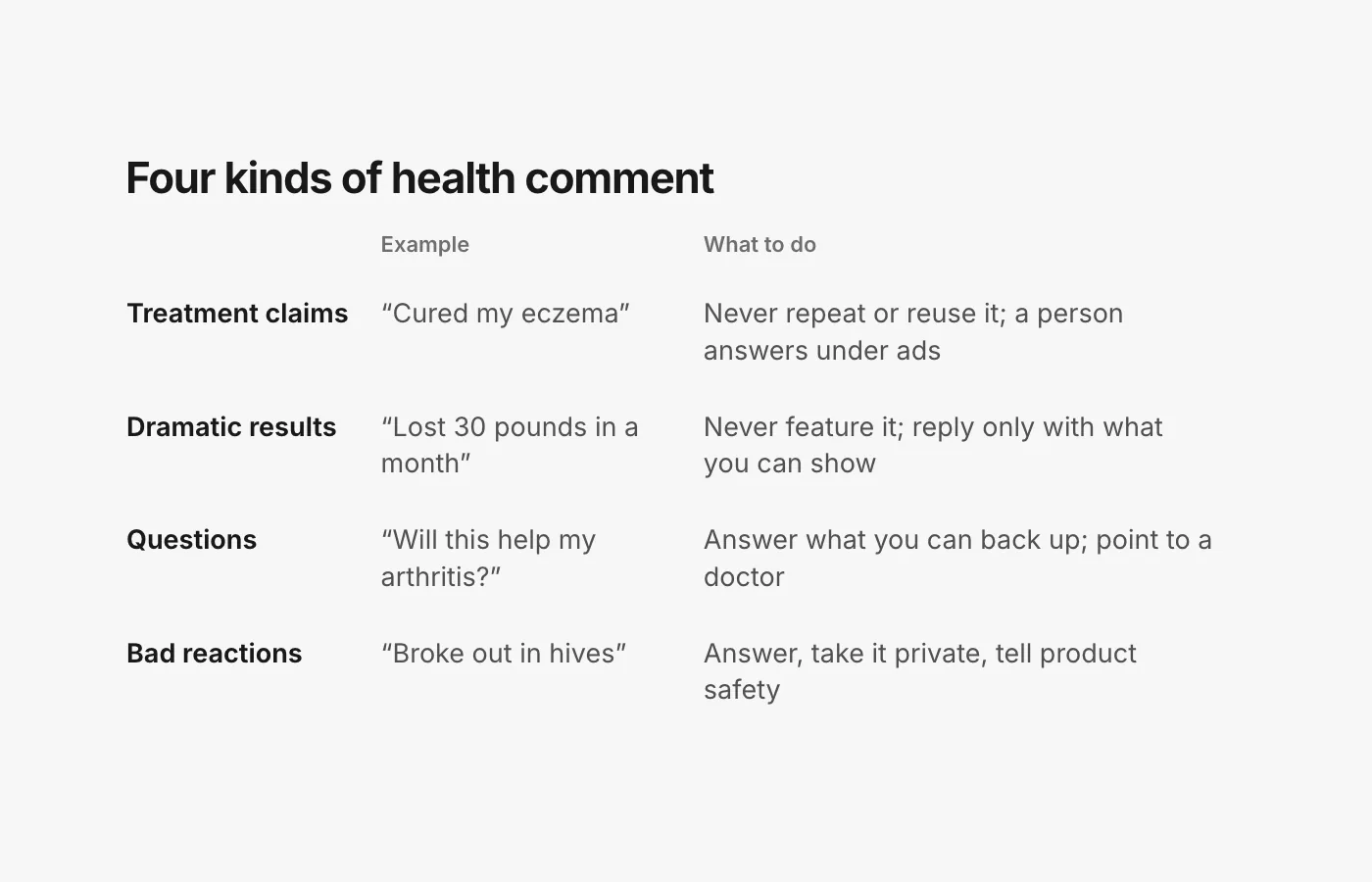
Treatment claims
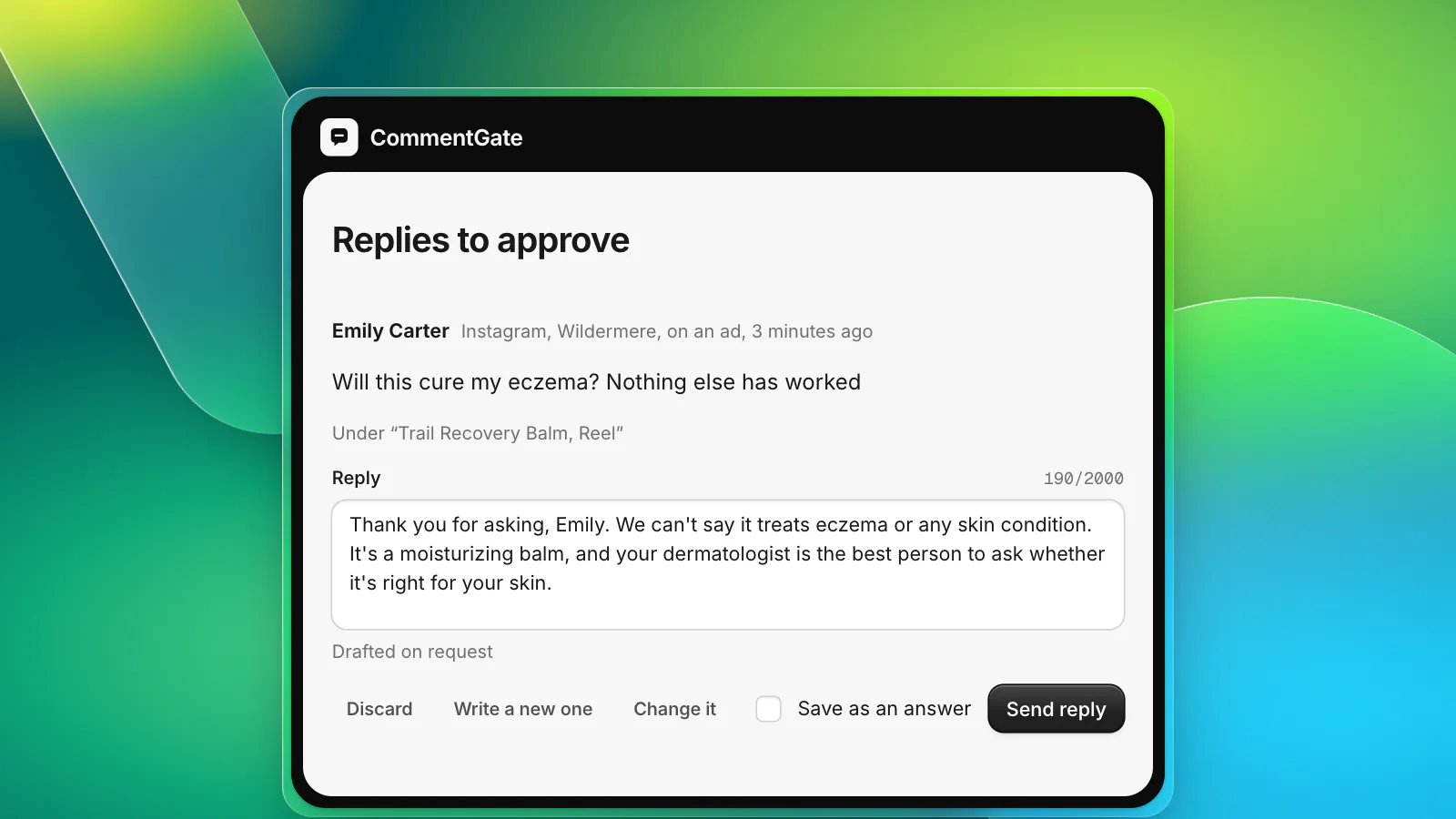
"Cured my eczema." "My blood pressure is down since I started these." Do not repeat it, pin it or reuse it. If you reply at all, thank the person without agreeing with the claim. Under an ad, send these to whoever handles compliance before anyone answers.
Dramatic results
"Lost 30 pounds in a month." "Grew back my hairline in six weeks." Leave the comment if it is honest, but never feature it. If you have real data on what customers generally achieve, that is what your reply can say.
Questions
"Will this help my arthritis?" "Is it safe while pregnant?" "Can I take it with my blood thinners?" These deserve an answer, and the answer must stay inside what you can back up. For anything medical, the honest reply points to a doctor or pharmacist.
Bad reactions
"Broke out in hives after two days." "Gave me heart palpitations." This is not a moderation question at all. Answer publicly, take it private, and send it to the person who handles product safety. Our guide to safety reports in comments covers what happens next.
Replies that stay on the right side
A few before-and-afters, for a skin balm:
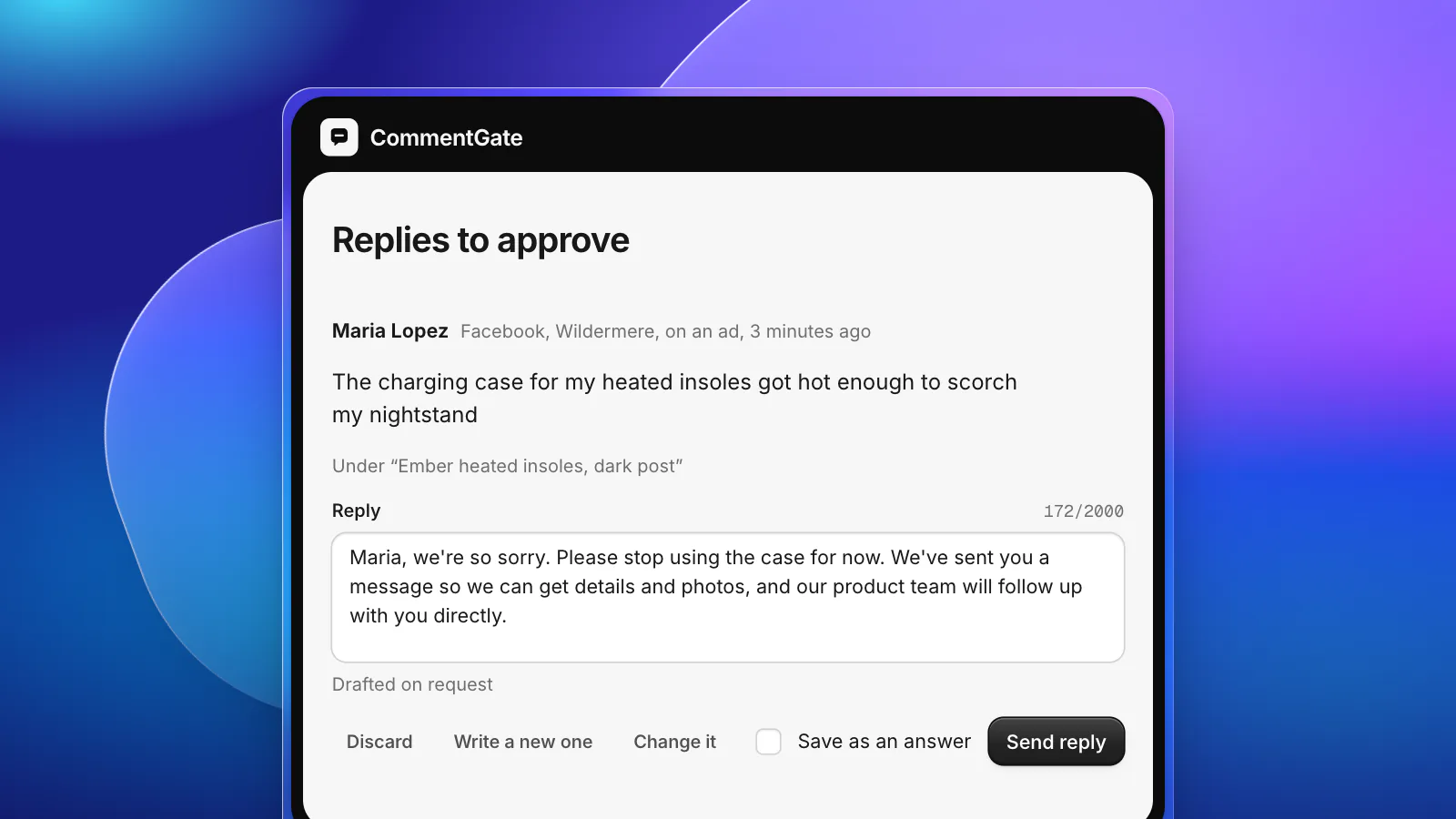
- Instead of "So happy it cured your eczema, Jess!" try "Thank you, Jess, we're really glad you like it. We can't say it treats any skin condition, so please keep your dermatologist in the loop."
- Instead of "Yes! Lots of customers use it for psoriasis" try "It's a moisturizing balm, and we can't say it treats psoriasis. Your doctor is the best person to ask about that."
- Instead of "Totally safe in pregnancy!" try "Please check with your doctor or midwife before using it while pregnant. The full ingredient list is on the product page."
Notice what the good replies do: they are warm, they answer, and they make no health claim of their own. Our health and safety claims templates have more of these ready to adapt.
Do not keep the praise and hide the complaints
It is tempting to leave every "miracle" comment up and hide every "did nothing for me". The 2023 Endorsement Guides address this directly: in "procuring, suppressing, boosting, organizing, publishing, upvoting, downvoting, reporting, or editing consumer reviews", advertisers "should not take actions that have the effect of distorting or otherwise misrepresenting what consumers think of their products" (FTC: 16 CFR Part 255).
A comment section where only the glowing results survive is exactly that kind of distortion. Hide comments for what they do (scams, abuse, spam, personal information), never for being unimpressed. Our guide to moderating fairly goes through where that line sits.
Your team, your friends and your giveaways
Two more cases from the FTC's answers that show up in comment sections:
- Employees. If someone on your team praises the product under your ads, they should say they work for you. The FTC says listing an employer on a profile page "isn't enough" (FTC: what people are asking).
- Incentives. If people comment as part of a contest or for a discount, their posts need to say so. A hashtag like "#XYZ_Rocks" is not enough; the FTC suggests putting "contest" or "sweepstakes" in it (same page).
If creators are posting about your product for you, our creator campaign guide covers their comment sections.
Setting this up in CommentGate
CommentGate takes this line almost as written:
- Medical claims under ads go to Needs you. Treatment claims and health questions under your ads wait for a person, each with a one-line reason, instead of being hidden or answered on a guess.
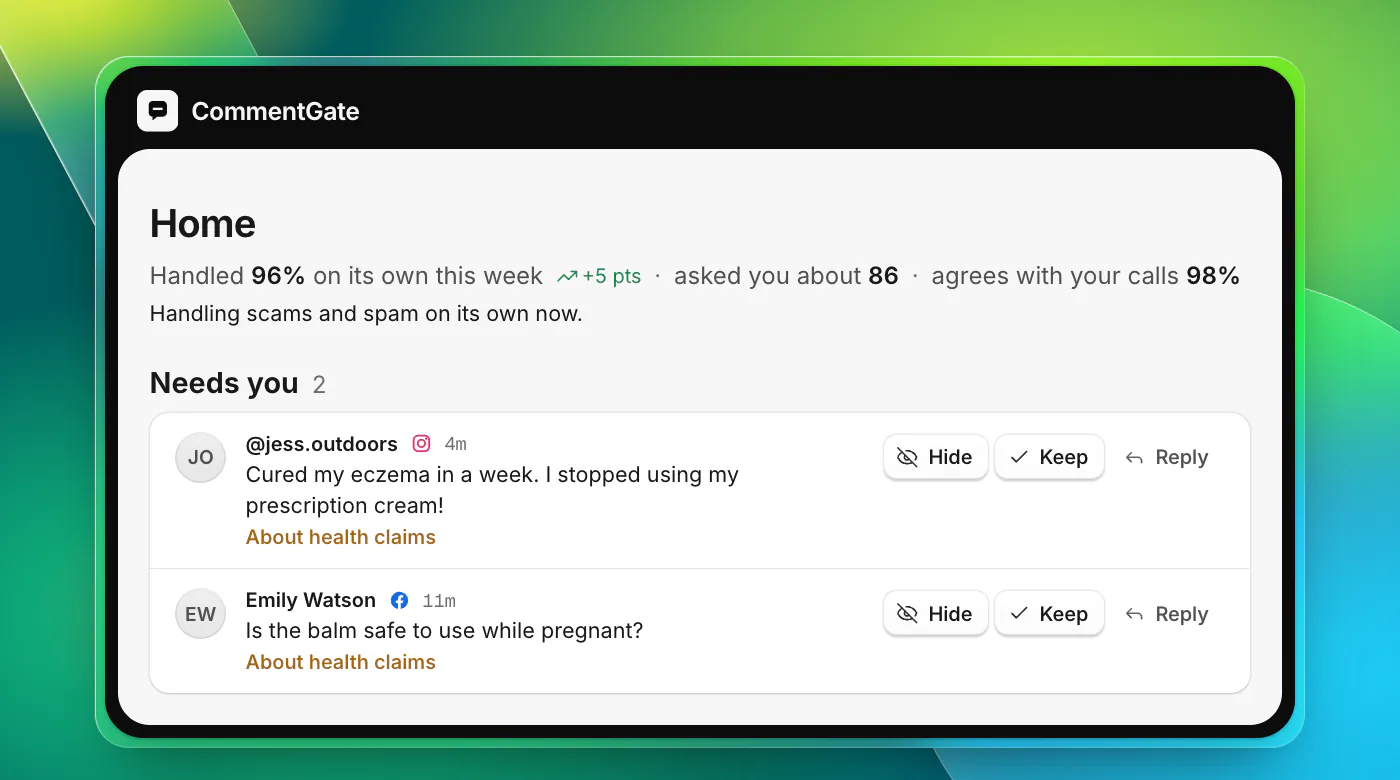
- Your own topics in a sentence. Describe what matters for your products ("comments claiming the product treats a condition") and CommentGate watches for it.
- Drafts that follow your rules. Put "Never say a product treats, cures or prevents anything" in your reply guidance, and drafted replies follow it. Keep health questions on Draft for me so a person approves every answer.
- Fair by default. Hiding negative comments is off from the start, so "did nothing for me" stays up next to the praise.
- Assign the hard ones. Hand a treatment claim to the person who handles compliance, with a note only your team sees (team inbox).
Everything else, from scams to spam to "where is my order", keeps running on its own.