Safety reports and recalls in your comments: respond, don’t hide
"The buckle snapped and cut my ankle." A safety report in your comments is information you may be required to act on, not a reputation problem to hide. Here is how to answer it, who to tell in the US, UK and EU, and how to run your comments during a recall.
Playbooks 6 min read
On this page
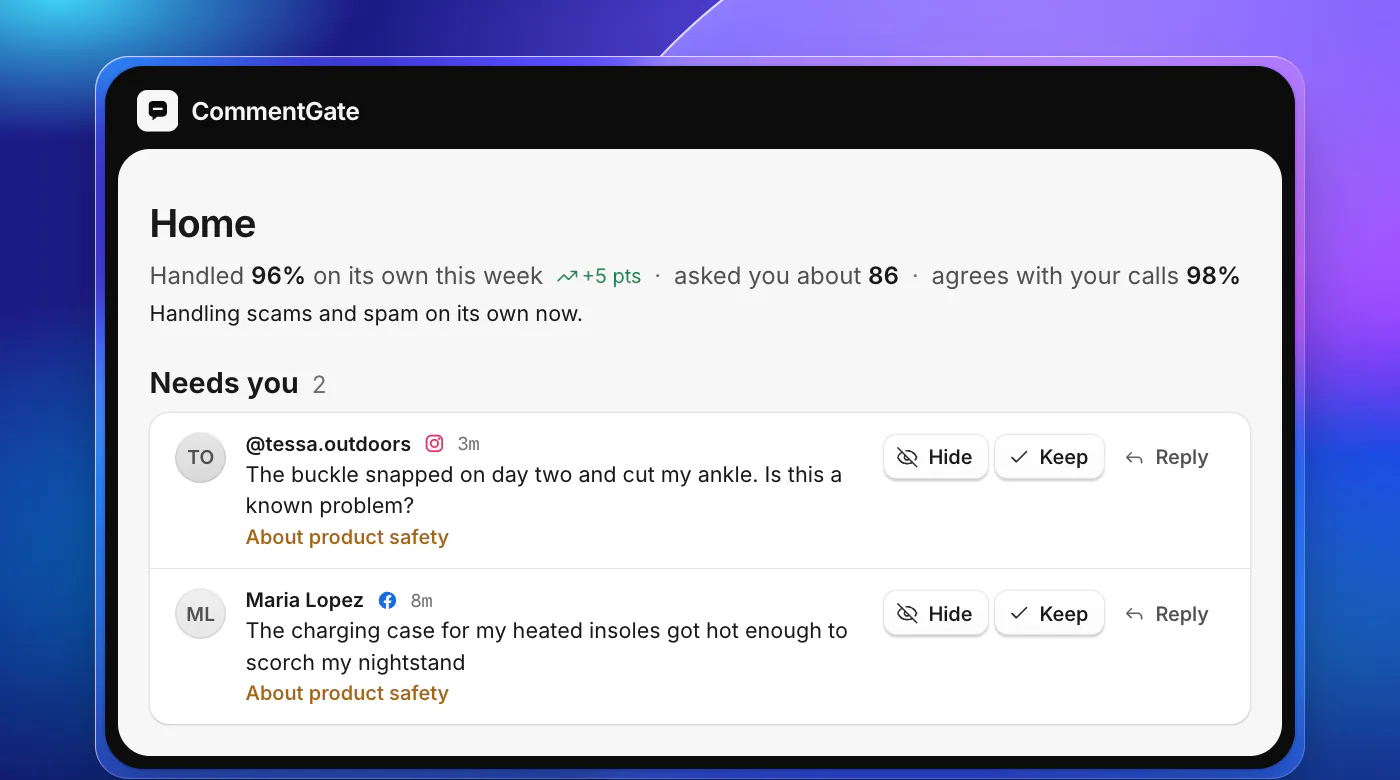
Most negative comments are about taste, price or a late package. A few are different. "The buckle snapped on day two and cut my ankle." "The charging case got so hot it scorched my nightstand." "My son's toy lost a wheel and he put it in his mouth."
The instinct, especially under a paid ad, is to make that comment go away. Resist it. A safety report is not a reputation problem that happens to be public. It is information about your product, and depending on what you sell and where, you may have a legal duty to act on it quickly.
Why hiding a safety report is the wrong move
In the US, the Consumer Product Safety Commission says that if you are "a manufacturer, importer, distributor, and/or retailer of consumer products", you have "a legal obligation to immediately report" certain information, including "a defective product that could create a substantial risk of injury to consumers" and "a product that creates an unreasonable risk of serious injury or death". It says a company "must report to the Commission within 24 hours of obtaining reportable information", that "the law does not require injury or harm to have occurred", and that staff's advice is "when in doubt, report" (CPSC: duty to report).
Retailers are on that list. If you run a store or a dropshipping brand, you are not outside this because someone else made the product.
Nobody can tell you from one comment whether it is "reportable information". What is certain is that you cannot evaluate a report you hid and forgot, and a hidden comment is exactly the kind of thing that disappears from memory by Monday. Hiding also removes the one public sign that you took it seriously, which is what every other reader is looking for.
How to spot one
Safety reports rarely use the word "safety". Watch for:
- Injury words: cut, burn, bruise, rash, hives, bleeding, choked, fell, hospital, ER.
- Failure words: snapped, cracked, shattered, came apart, melted, smoking, sparked, overheated, leaked.
- Children, pets or pregnancy anywhere near the product.
- Photos of damage or injuries, sometimes with no words at all.
The first public reply
Answer in public, once, and move the rest to a private conversation. A good first reply does four things:
- Acknowledges it without arguing or minimizing: "We're so sorry, this is not okay."
- Puts safety first: "Please stop using it for now."
- Moves it private: "We've sent you a message so we can get the details and photos."
- Does not diagnose. No "you must have used it wrong", and no promises about causes you have not investigated.
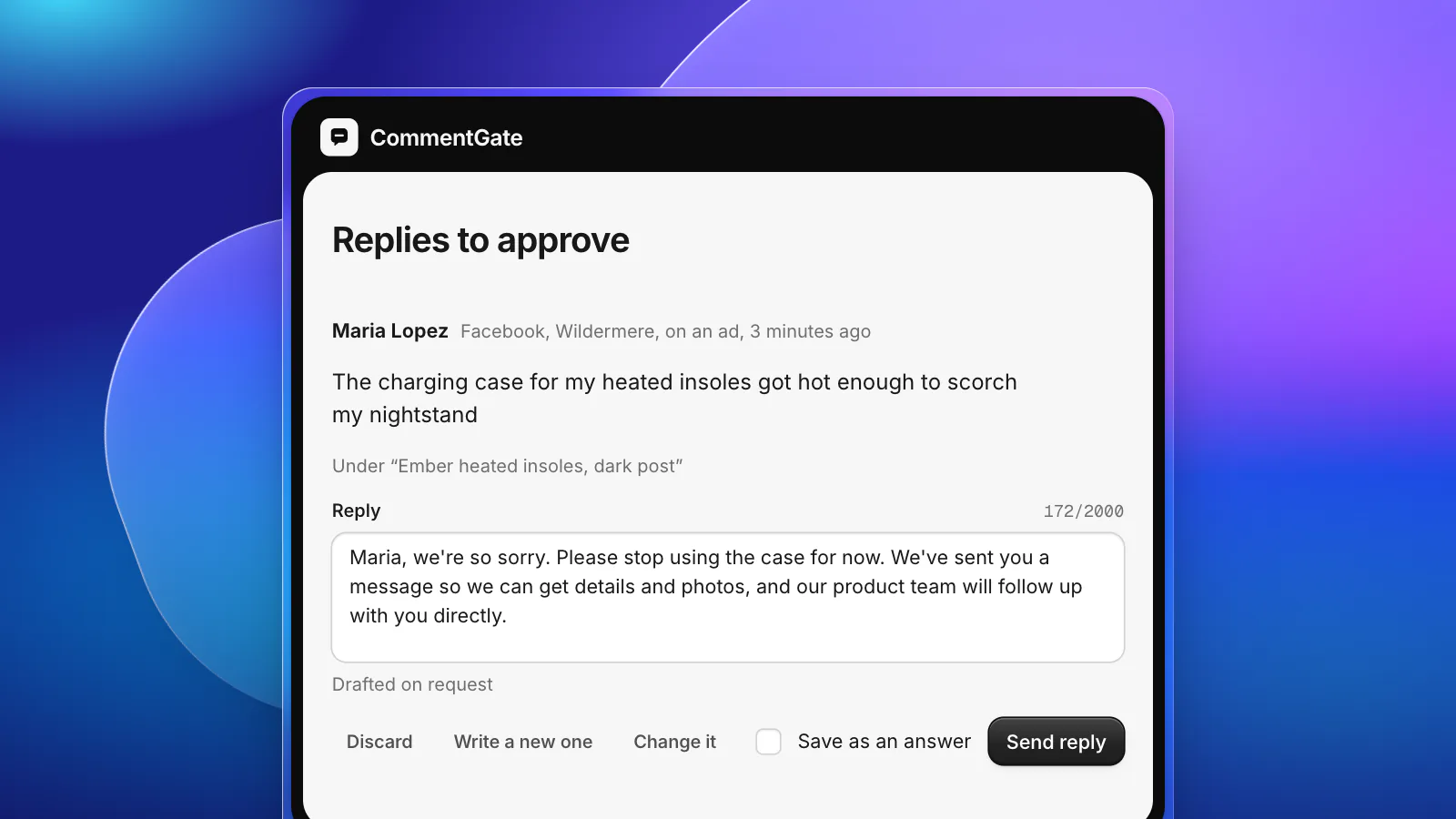
For example: "Maria, we're so sorry. Please stop using the case for now. We've sent you a message so we can get details and photos, and our product team will follow up with you directly."
The CPSC gives recalling companies the same shape of advice for social media: firms "should acknowledge customer inquiries by responding on the social media platform at least once", and move further conversation to a phone number or email so the customer reaches customer service directly (CPSC: social media guide for recalling companies).
Behind the scenes, the same day
- Capture it. Screenshot the comment and any photos, and save the link, the time and the author's handle. Comments get edited and deleted.
- Route it to the one person who handles product safety, today, not in the weekly review.
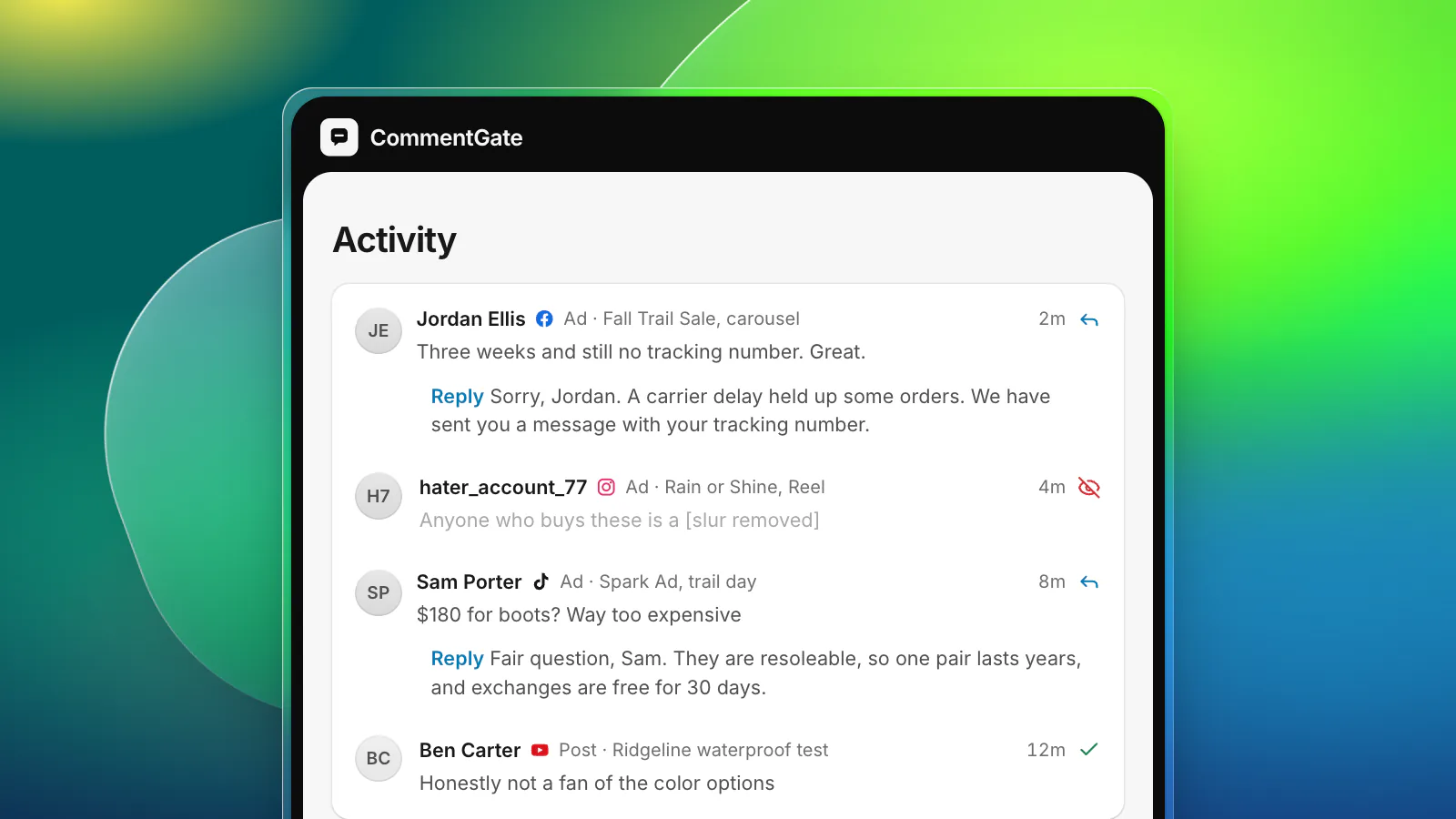
- Keep it up. Hide it only if it contains personal information, and answer before you hide.
- Look for more. Search your other posts and ads for the same product and the same failure. Three similar comments are a pattern.
Who to tell
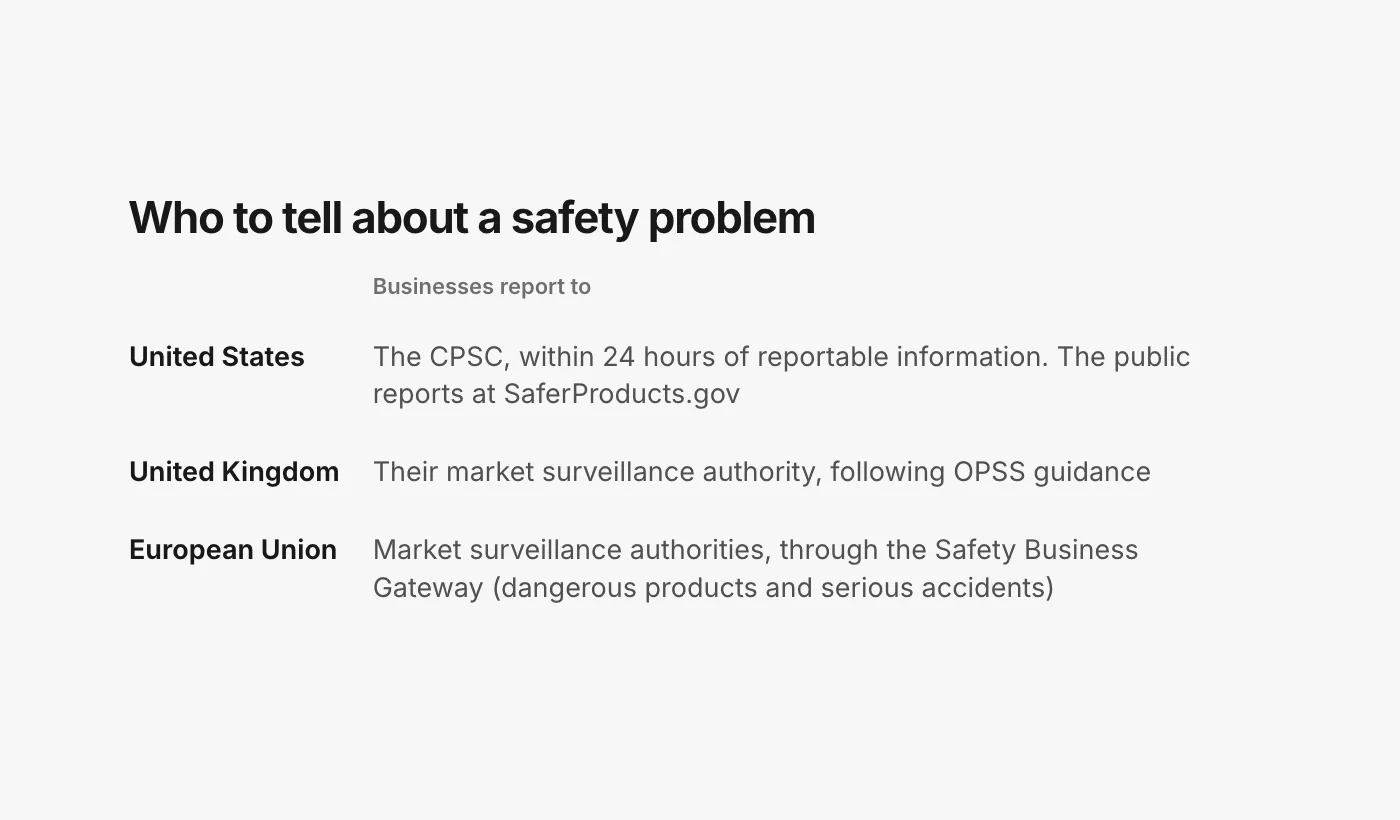
- United States. Businesses report to the CPSC (CPSC: duty to report). The public can report unsafe products at SaferProducts.gov, and businesses can register there to receive and respond to reports about their products (SaferProducts.gov).
- United Kingdom. The Office for Product Safety and Standards publishes guidance for businesses that need to notify their market surveillance authority of an unsafe product they have placed on the market (GOV.UK: product recalls and alerts).
- European Union. Under the General Product Safety Regulation, the Safety Business Gateway is the portal "through which businesses must inform the Member States' market surveillance authorities about dangerous products and accidents", and its use "is mandatory for businesses to comply with their reporting obligations" (European Commission: Safety Business Gateway guidelines).
If you sell into Canada, Australia, Brazil or Japan, each has its own product safety regulator and rules. Check with the regulator in each market before you need it.
When there is a recall
A recall turns your comment section into a customer service desk. The CPSC's guide for recalling companies is specific about social media. Companies "are expected to use any and all social media and mobile platforms on which the company maintains a presence" to notify consumers, and "are encouraged to use paid advertising on social media". Its requirements for the posts themselves: use the words "recall" and "safety", keep it concise ("#Recall hashtag, product name, hazard, remedy"), link directly to the recall page, use photos, make the recall a featured post if possible, and "use direct messaging to answer recall questions from consumers". And: "Recalling companies should have their staff or a PR agency monitor activity to respond to questions and comments" (CPSC: social media guide).
In practice, for your comments:
- Pause the ads promoting the recalled product. A cheerful creative collecting "is this the one that caught fire?" comments helps nobody.
- Keep comments open on the recall posts. They are where customers ask whether their unit is affected.
- Answer every recall question with the same facts and the recall page link, in varied words, so it does not read like a bot.
- Hide what exploits it. Recalls attract fake refund accounts and phishing links aimed at worried customers. Those go, every time. Our guide to phishing links in comments covers the patterns.
- Keep the complaints. Anger about a recall is fair. Answer it.
The crisis-day checklist covers the rest of a day like this.
How CommentGate handles safety reports
Safety reports are one of the judgement calls CommentGate never makes on its own:
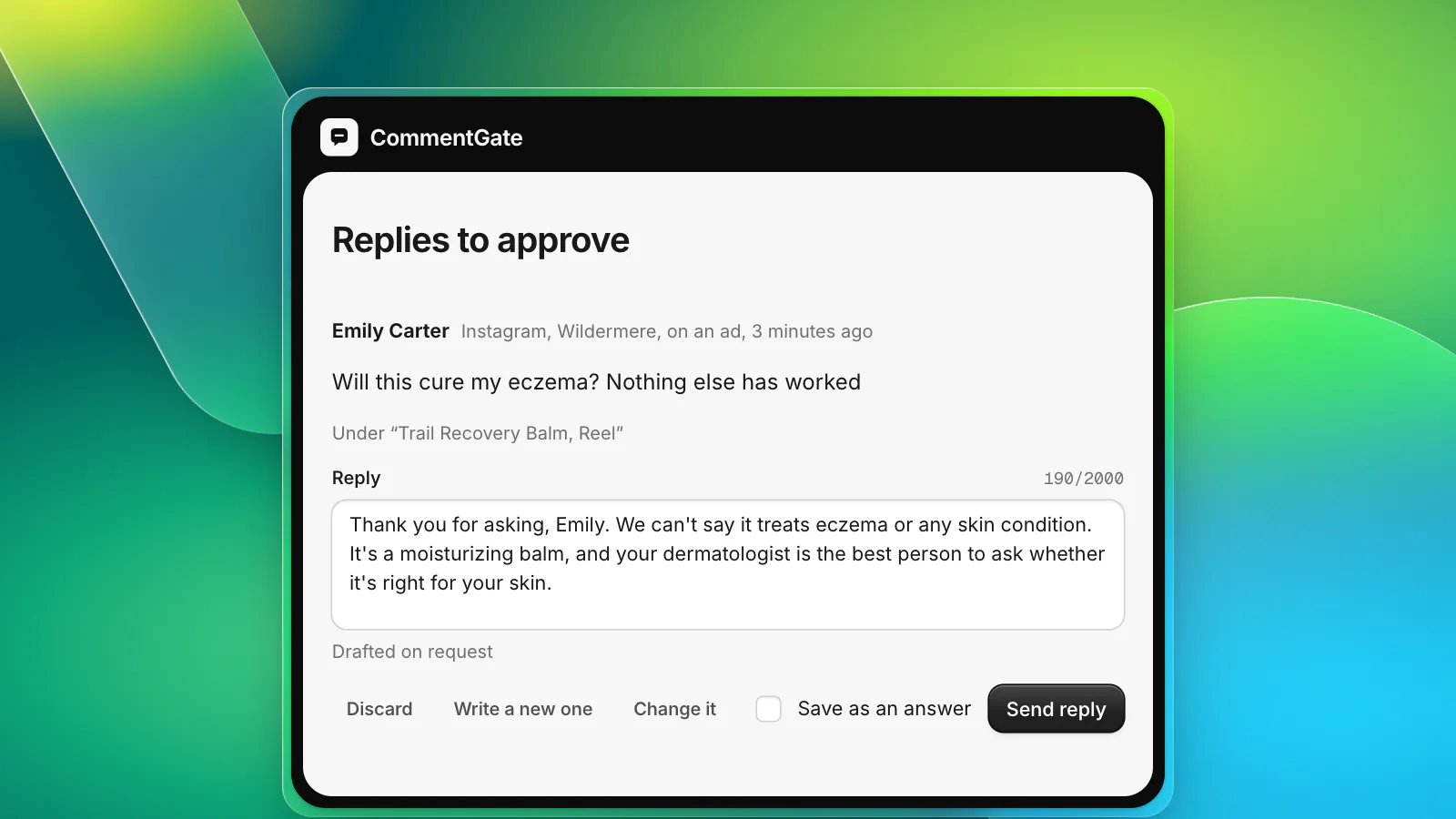
- Defect and injury reports go to Needs you with the reason "About product safety" and a one-line note, on every platform, whether they are on a post or an ad. They are not hidden and not answered on a guess.
- Assign it to your product lead with a note only your team sees, and the comment's full history (when it came in, who decided what, every reply) stays with it (team inbox).
- Your own topics in a sentence. During a recall, describe "questions about the Ridgeline recall" and CommentGate watches for them, and add the recall facts to your notes so drafted answers use them.
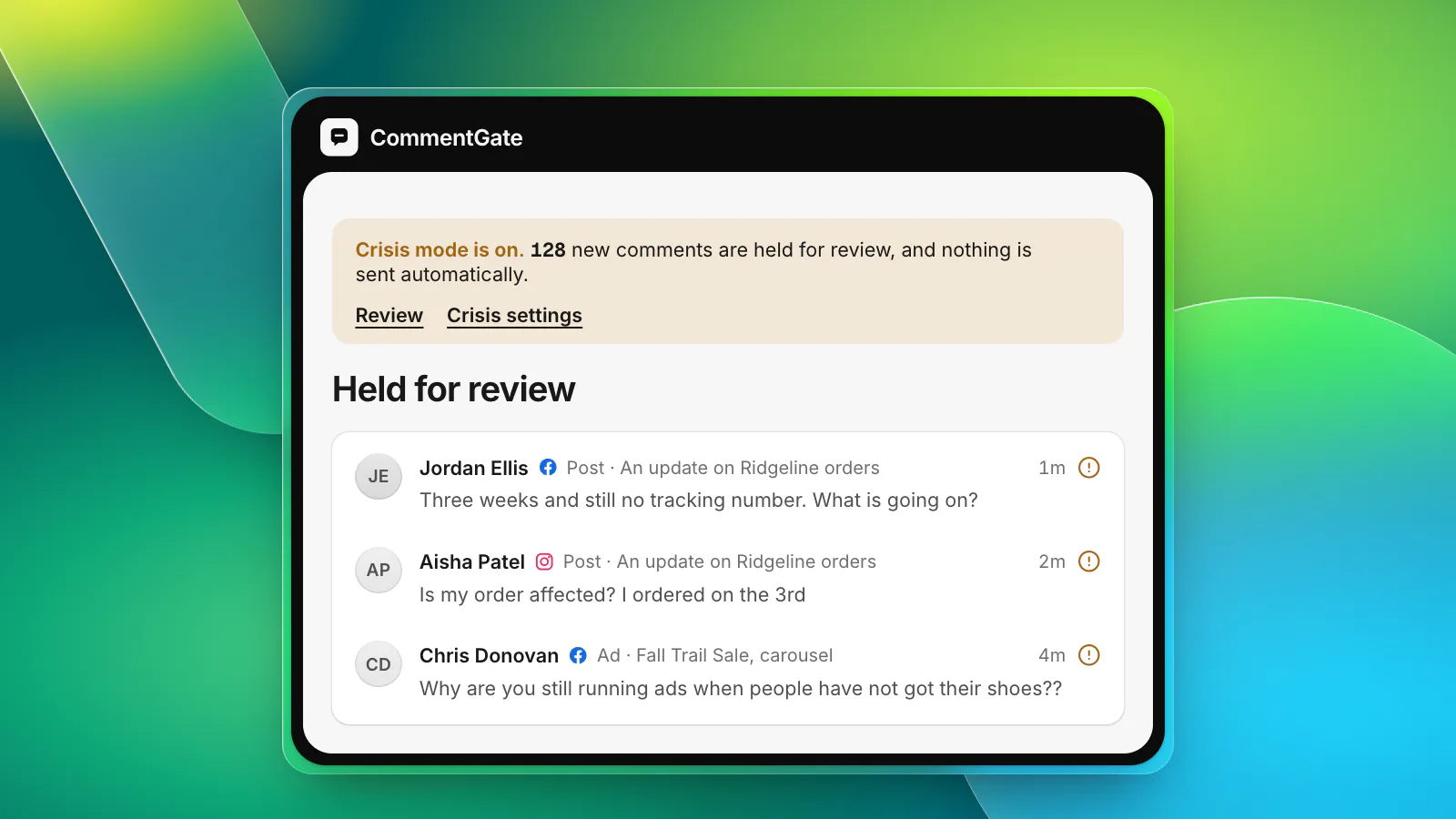
- Crisis mode holds every new comment for a person and stops everything automatic, on every account or only the brand involved, for the first hours when you do not yet know what to say (crisis mode).
- Scams do not wait. Outside crisis mode, fake refund accounts and phishing links aimed at worried customers are hidden within seconds on Facebook and Instagram.
Our health and safety claims templates have first replies you can adapt.
Sources
- CPSC: Duty to report to CPSC, rights and responsibilities of businesses
- CPSC: Social media guide for recalling companies
- CPSC: SaferProducts.gov
- GOV.UK, Office for Product Safety and Standards: Product recalls and alerts
- European Commission: Guidelines for the practical implementation of the Safety Business Gateway (C/2025/6238)